
Each buyer sets their own offer based on the condition, location, and current market in your area. The offer will typically be below full market value, but you won’t pay commissions or make repairs, and the buyer usually covers typical closing costs. In a market where 1 in 5 listings takes a price cut, many sellers find the certainty of a cash offer worth the trade-off.
Sell my house fast in Nevada
From Las Vegas to Reno to the rural counties in between, get a fair cash offer on your home as is.
|
Median sale price
$468,051
Statewide median for Nevada home sales as of August 2026.
|
Median days to closing
93 days
About 63 days from listing to going under contract and another 30 days to close.
|
 About 1 in 5 listings took a price cut
Roughly 20% of Nevada listings had their price reduced before selling. Sellers who price too high often end up lowering it anyway, after weeks of showings.
-
Many Nevada homes come with an HOA resale package
About 502,000 Nevada homes sit in more than 4,000 homeowners associations. Selling in one means ordering a resale package for the buyer, who can cancel until midnight of the fifth day after receiving it.
We buy houses in Nevada
Whether you’re in Las Vegas, Reno, or anywhere in between, the process with SellMyHouse.co works the same way.

STEP 01
Request your cash offer
Give us the basics on your Nevada property online in just a few minutes.

STEP 02
Schedule a property visit
A cash home buyer comes by once to see the home, on a day you pick.

STEP 03
Review your offer
Weigh the offer on your own time, with no obligation either way.

STEP 04
Close on your schedule
Set the closing date that suits you, then collect your proceeds at closing.
Why sell your Nevada house with SellMyHouse.co
A 93-day timeline is the state average. Not every seller can wait that long, and not every property qualifies for a conventional sale. Here’s what’s different when you sell to a cash home buyer:
- No repairs needed. Cash home buyers in our network buy homes in almost any condition, so you can request an offer without fixing, cleaning, or updating anything first.
- No agent commission. There’s no listing agent fee deducted from your offer, so you can sell your home without that additional cost.
- The buyer typically covers closing costs. Title, escrow, and other standard seller-side closing costs are typically covered by the buyer.
- Close on your schedule. Whether you need to move quickly or want more time to plan your next move, the buyer can typically work around the closing date you choose.
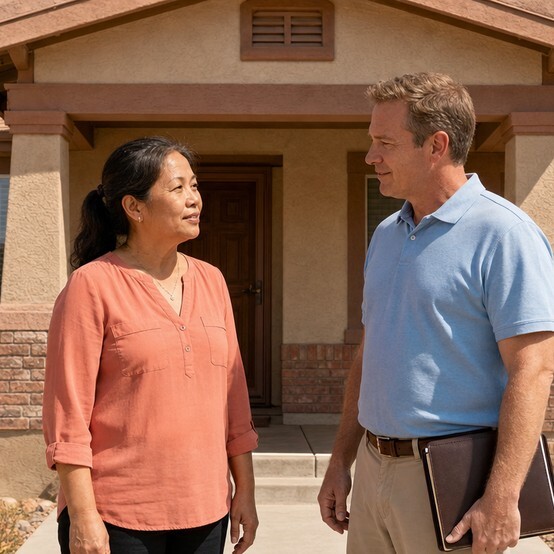
Nevada homeowners relocating for a new job often find a cash offer the most practical path to closing on a firm date.
What Nevada sellers need to know
Before you sell in Nevada, it helps to know what the state requires you to disclose, what property transfer costs, how foreclosure works, and how much of your home equity is protected. Nevada homeowners selling an inherited property often have title and estate questions to sort out before they’re ready to sell.
Seller’s Real Property Disclosure
Nevada law (NRS 113.130) requires sellers to give the buyer a written disclosure of known issues that affect the property’s value or use, at least 10 days before closing. The form covers electrical, heating, cooling, plumbing, and sewer systems, among other things. A seller who fails to disclose a known issue can owe treble damages plus court costs and attorney’s fees (NRS 113.150). Cash home buyers often purchase as is, so disclosed issues typically don’t derail a sale the way they can with a financed buyer.
Real property transfer tax
Nevada charges a real property transfer tax of $1.95 to $2.55 per $500 of value, depending on the county (NRS Chapter 375). At the base rate, a home sold at the $468,051 median owes roughly $1,825 at closing. The buyer and seller are jointly responsible by law, though the purchase contract typically specifies who pays.
Nonjudicial foreclosure
Most Nevada lenders foreclose through a trustee sale without going to court (NRS 107.080). After a Notice of Default, the homeowner has 3 months to bring the loan current, and the full process takes about 4 months. There’s no right to reclaim the home after the sale. Anti-deficiency rules (NRS 40.455) generally keep the lender from pursuing a remaining balance on original purchase loans for owner-occupied homes, but typically not after a refinance.
Homestead exemption
Nevada’s homestead exemption (NRS 115.010) protects up to $605,000 of home equity from most general judgment creditors, one of the highest amounts in the country. This protection isn’t automatic: you must file a free homestead declaration with the county recorder (NRS 115.020). It doesn’t stop your mortgage lender from foreclosing, and it doesn’t cover property tax or mechanic’s liens.
Frequently asked questions
How much will a cash home buyer offer for my Nevada house?
How does foreclosure work in Nevada?
Most Nevada foreclosures run through a trustee instead of a court. A Notice of Default gives you 3 months to bring the loan current; if that deadline passes, the trustee sale follows with at least 21 days’ notice, taking about 4 months from start to finish. You can’t get the home back once it sells. Many owner-occupants are also protected from being pursued for a remaining balance, though that protection can end if you’ve refinanced. Selling before the sale date lets you pay off the loan on your own terms.
Does Nevada charge a real estate transfer tax?
It does, and the rate depends on which county the property sits in, anywhere from $1.95 to $2.55 per $500 of value. On a median-priced Nevada home, that lands around $1,825 at the base rate. The buyer and seller are technically both responsible by law, though the contract usually specifies who actually pays.
What does Nevada’s seller disclosure law require?
Nevada sellers generally must disclose known property defects in writing at least 10 days before closing. Failing to disclose certain issues can expose sellers to liability for damages and legal fees. Selling to a cash buyer does not eliminate the disclosure requirement.
Do I have to make repairs before selling to a cash home buyer?
No. Cash home buyers in our network purchase homes in almost any condition, so you don’t have to spend money getting the property ready before you receive an offer.
How fast can I close when I sell my house in Nevada?
Many cash sales wrap up faster than a standard Nevada listing, since there’s no traditional lender holding up the timeline.